ch39 What should we preach?

ch39 What should we preach? is a study tract examining the Bible's comments on good and bad preaching. Topics: What is biblical preaching? Wholesome Doctrine; Good Doctrine produces Piety; Bad doctrine and preaching; Strong Reproof; Preaching to Entertain; and Beneficial Preaching.

ch39 What should we preach? is a study tract examining the Bible’s comments on good and bad preaching. Topics: What is biblical preaching? Wholesome Doctrine; Good Doctrine produces Piety; Bad doctrine and preaching; Strong Reproof; Preaching to Entertain; and Beneficial Preaching.

What should we preach?
The ministry of the Word

What should we preach?
Por David Cox

[ch39] v1 ©2009 www.coxtracts.com
You may freely print this tract for non-profit purposes

See copy of this tract on churchplantingworkshop.com https://www.churchplantingworkshop.com/improving-preaching/what-should-we-preach/https://www.churchplantingworkshop.com/uncategorized/what-should-we-preach/ Note that in the sidebar, there are more posts on improving your preaching.

What is “biblical preaching”?
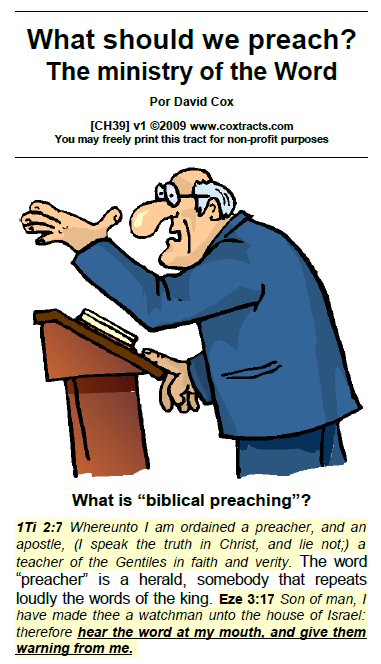
ch39-what-do-we-preach-v1r-b1Ti 2:7 Whereunto I am ordained a preacher, and an apostle, (I speak the truth in Christ, and lie not;) a teacher of the Gentiles in faith and verity. The word “preacher” is a herald, somebody that repeats loudly the words of the king. Eze 3:17 Son of man, I have made thee a watchman unto the house of Israel: therefore hear the word at my mouth, and give them warning from me.

It is important that preachers concentrate in their preaching on what God has commanded us to preach (nothing more, nothing less, nothing else, completely). In our day, many pulpits have sidetracked into sermons, content, and non-biblical elements such as jokes, stories, and current events. In this tract we examine what we are, and are not, to preach. Continue reading


ch45 Grading a Bible Teacher

Grading Your Bible Teacher

Grading a Bible Teacher is a guide for understanding the false or bad teacher of the Bible from a true man of God.

Grading a Bible Teacher

By David Cox v1 © 2011
[ch45] www.coxtracts.com
Permission is given to photocopy for non-profit use


For the time will come when they will not endure sound doctrine; but after their own lusts shall they heap to themselves teachers, having itching ears; 2Tim 4:3

Today it is in fashion to reject the traditional local church and a good pastor in order to sit under expert Bible teachers. Typically these are charismatic personality teachers, that people just love to hear. From hearing their followers, “everybody should leave their local churches and come study with these great teachers.” The Bible has a response to this, and it is the model for learning which God has given us, in a local church with a qualified pastor. Continue reading

ch15 Congregating because we Love

Congregating because we Love

Congregating because we Love is a tract about why we attend church. Our relationship with our brethren in Christ is highly integrated with our salvation. This tract, Congregating because we Love, explains part of that. Congregating because we Love

By Pastor-Missionary David Cox
[CH15] v2©2013 www.coxtracts.com
You may freely reprint and copy this tract for free distribution


Psa 122:1 I was glad when they said unto me, Let us go into the house of the LORD. 

Psa. 50:5 Gather my saints together unto me; those that have made a covenant with me by sacrifice.

Salvation is often misunderstood. When God saved us, He made us part of the redeemed and the body of Christ. Salvation unites us with the community of the redeemed, the community of faith, with the saved by Jesus Christ. Believers get together the day God chose (Sunday) for the purposes He chose. Salvation is not something isolated from the present until after death, but is something that is active, dynamic, and fills our life from the moment of salvation until our death and for all eternity.

The life of every believer should be centred in communion with the other redeemed in the church, and afterwards in heaven. Heaven is to live together with God and the rest of the redeemed. God had his purposes in saving us, and the main purpose is to form us into part of His work (extending the kingdom of God) for His glory. We should shine our best for God before the world. Continue reading

ch28 Difference between sheep and goats?

Do you know the difference between a sheep and a goat?
Profile of goats
By David Cox
[ch28] v1 ©2008 www.coxtracts.com
This tract can be freely reproduced for non-profit use.


“And before him shall be gathered all nations: and he shall separate them one from another, as a shepherd divideth his sheep from the goats: And he shall set the sheep on his right hand, but the goats on the left.” Mat 25:32-33

The Bible describes the truly saved ones as sheep. But it also speaks of goats among the sheep. The difference between the two is tremendous. Have you considered how you fit into one of these categories, sheep or goat?

Continue reading

ch29 The Marks of a Christian (Study of 1 John)

ch29 The Marks of a Christian (Study of 1 John) is a study of what are the marks of a Christian throughout the book of 1st John.

ch29 The Marks of a Christian (Study of 1 John) is a study of what are the marks of a Christian throughout the book of 1st John.

The Marks of a Christian according to 1 John

By David Cox

v1 ©2008 www.coxtracts.com
You may freely reproduce this tract for non-profit purposes.

The Apostle John in his first epistle presents us with the marks of a true Christian. It is important that every Christian meditates on whether he himself is a true Christian, and if he is truly saved, and a part of the body of Christ. No member of a body can exists alone, apart from the rest of the body, without having exchange with the rest of the members of the body. The Christian must base his spiritual life in identification with this body of Christ, and with the work of God that makes up the body of Christ, and to function within that body.

To understand this, we need to study Matthew 25:31-46.  God is going to judge each person as being saved or not by how they have a relationship with Jesus Christ. The point of this teaching is to make us understand that our love of Christ (which is absolutely necessary to be saved) manifests itself in our relationship with the rest of our Christian brethren.

John declares in his first epistle who are our brethren with whom we must do to show our true love of God. By establishing these marks God helps us not to fail in tricks and traps with deceivers or people seeking to take advantage of our love of Christ without them loving Christ.

Continue reading

Ch11 True Praise

True Praise

By David Cox

[ch11] v1 ©2012 www.coxtracts.com
This tract can be reproduced for non-profit purposes.


Thou shalt fear the LORD thy God; him shalt thou serve, and to him shalt thou cleave, and swear by his name. He is thy praise, and he is thy God, that hath done for thee these great and terrible things, which thine eyes have seen.

What is praise? How is it different from worship? (according to the Bible of course). Well, praise is to say something good about somebody. If a mother rises at 5:00 AM every day to prepare a good breakfast for her kids, does other beneficial things, then her children may “praise her” for the good that she has done them. When they do this publicly, then that is praise. So in praise, we publicly recognize the acts of God for humanity which are good, great, and excellent, and in so doing, reflect God’s benevolent character.

But thou art holy, O thou that inhabitest the praises of Israel.In a sense, God dwells in these “praises of men”. God is highly pleased when men praise Him. The Psalmist presents God as living or inhabiting in the midst of these praises.

Praise ye the LORD. Praise ye the LORD from the heavens: praise him in the heights. 5Let them praise the name of the LORD: for he commanded, and they were created. 6 He hath also stablished them for ever and ever: he hath made a decree which shall not pass.

We are to praise our God because He is worthy to be praised (; ). Praise begins and focuses on God. Praise does not start out as something emotional (although it can get emotional), but it is a spiritual activity of the will, something we are obligated to do. Praise is spiritual, and is created by the mind and soul meditating on God before seeking to be moved by the emotions (it neither excludes the emotion nor exalts them but allows them when it is appropriate). Continue reading

ch19 Marks of a False Prophet

The Marks of a False Prophet

Marks of a False Prophet

This tract explains what the Bible says about a False Prophet, and identifies it for us.
How to recognize a bad minister

By David Cox
[ch19] v1 ©2006 www.coxtracts.com
This can be freely copied if unaltered.

1 John 4:1 Beloved, believe not every spirit, but try the spirits whether they are of God: because many false prophets are gone out into the world.


Continue reading

ch32 How to pray for missionaries

How to Pray for Missionaries

By David Cox
[ch32] v1 ©2006 www.coxtracts.com
This may be freely printed and distributed if unchanged.


“Brethren, pray for us” – Missionary Paul
1 Thessalonians. 5:25

Every true and obedient Christian should be concerned for and striving to labor in the work of the Lord. If the work of the Lord is a war against Satan, then it is only through the prayers of the saints that any Christian warrior can do anything.

Many Christians in the states are highly concerned about advancing the work of the Lord around the world through missions, but they wonder how can I do this best? How and for what should I pray for these warriors on lonely and spiritually dry fields of service so far away? We will try to give some tips that should help.

(The author is a missionary of 20+ years on the foreign mission field, the first 9 years as a single missionary.) Continue reading

ch20 Why we call ourselves “Baptists”

What is a Baptist?

Baptists: Why we call ourselves “Baptists”? What does “Baptist” mean?

By David Cox
[ch20] v1 ©2006 www.coxtracts.com
This tract can be freely reproduced for non-profit purposes.


Many religious groups proclaim “We are not a religion. We are not a denomination, and because of that we don’t use any name except ‘church’. Names are bad.” But it is as if a person goes to the doctor and the doctor gives a prescription but he doesn’t want to write down the name of the medicine, and just writes “that medicine”. It is useless. We use labels and names to identify what is what. Each name has a meaning, and we use these labels to correctly identify things. This tract will explain why we use the name “Baptist”.

Whatever name we choose to call ourselves by, wicked people can attack us, and without a doubt, somebody will come out using that name without really having the significant life, conduct, and doctrine which should go with that name. The only thing that we can do is to make it very clear what are our beliefs and conduct (defining the label as we understand it) and defend ourselves. Continue reading